Due to technical difficulties, this Pheno Forecast is not currently being updated for 2026. Please check back next year for updated map status.
European spongy moth (formerly gypsy moth) caterpillars feed on deciduous trees, causing major defoliation and tree mortality. They are considered one of the worst forest pests in the United States.
WHAT ARE PHENO FORECASTS?
Pheno Forecast maps predict key life cycle stages in invasive and pest species, to improve management efficacy. For insect pest species, Pheno Forecasts are based on published growing degree day (GDD) thresholds for key points in species life cycles. These key points typically represent life cycle stages when management actions are most effective. These maps are updated daily and available 6 days in the future.
Help us improve these maps! Our Pheno Forecast map products are still in development, and we seek input on their performance in your area. Give your feedback at the bottom of the page.
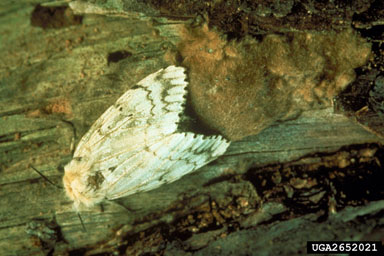
SPECIES BACKGROUND
Spongy moth (Lymantria dispar) egg masses hatch in late spring and the caterpillars feed extensively on many types of trees, favoring oaks, birches and poplars. Spongy moth caterpillars spend the day hidden in leaf litter or under bark, and ascend their tree at night to feed. Spongy moths are native to Europe and Asia.
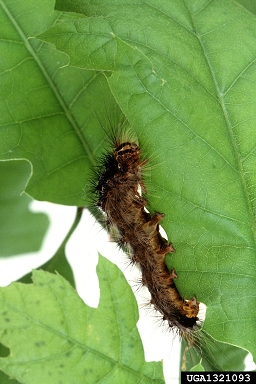
CATERPILLAR FORECAST
We forecast caterpillar emergence based on growing degree days. Certain control measures are most effective when caterpillars have recently emerged from their egg masses. For specific information on preferred treatment options in your region, we recommend contacting your local extension agent. Additional identification and treatment resources are available through USDA APHIS and UMass Extension.
| Phenophase | GDD threshold | Base temp | Upper threshold | Start date | GDD method | Model origin | Source |
|---|---|---|---|---|---|---|---|
| Caterpillar emergence | 571oF | 37.5oF | 104oF | Jan 1 | Double sine | PA, WV | Russo et al (1993) |
More information on map development and re-use policy.